Selected Foreign Articles · 7 Career Truths No One Told You
Here’s your cognition booster — sec One-Second Cognition
We handpick top foreign publications from around the world to break down the underlying logic of the world for you. This isn’t scattered motivational fluff — it’s hardcore, digestible insights worth revisiting.
Have you noticed that the hardest-working, most capable people at work often get promoted slowly? You work overtime but see no reward, or even get sidelined — doesn’t that feeling of powerlessness cut deep?
Actually, behind this lies a set of unwritten “rules” no one talks about.
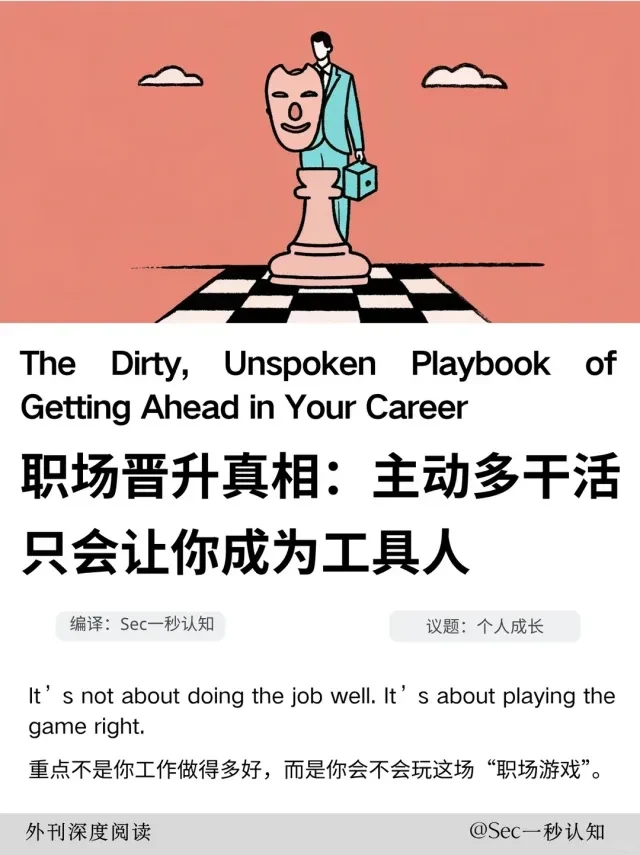
Foreign publications point out: “It’s not about doing the job well. It’s about playing the game right.”
The key isn’t how well you do your job, but whether you can play the ‘career game’ smartly.
Promotion isn’t just about effort and skill — it’s more about understanding how to cleverly play within the rules of the workplace.
Here are the core insights:
🔹 High performance ≠ high promotion rate
Employees who are highly efficient often get ‘pinned’ to their current role, becoming the team’s ‘output machine.’ Leadership roles, however, value management and coordination skills more.
🔹 The workplace is like a game of power
Promotion depends on networks, relationships, and strategic flattery — not just job performance. Remember: “Being well-liked by the right people beats just being good at your job.”
🔹 Avoid overcommitting
Taking on extra work often just leads to unpaid overtime without promotions, and might even make you ‘cheap labor.’
🔹 Information is power
Skillfully mastering key skills and information, and creating indispensability, is the survival law of the workplace.
🔹 Know when to ‘shift blame’ and ‘bite your tongue’
Strategically avoiding excessive responsibility, knowing how to sidestep risks, and protecting yourself from being sacrificed are crucial.
From these points, we can draw some practical advice:
Don’t blindly work overtime — focus your energy on building key relationships and influence.
Recognize the core of power, spend time understanding who the real decision-makers are, and play to their likes.
Master unique skills to make yourself irreplaceable, but don’t make everything overly transparent.
Learn to ‘look busy’ or perform strategically — don’t reveal your full workflow.
Take responsibility cautiously, identify risks, and learn to reasonably pass off or minimize mistakes.
Build your own workplace ‘alliance’ and consciously seek support and protection.
Finally, ask yourself:
Are you stuck in the career loop of ‘effort with no reward’? Have you considered that succeeding isn’t just about skill, but also about strategy?